
White Paper
How AI is breaking the legacy BI/SI model, and what it means for enterprise value
Download the original white paper (DOCX, English)
At a glance
- The ModelThe traditional BI/SI model is obsolete.
- Running an ERP programme through workshops and person-days is no longer the best way to do it, and soon it will be hard to defend.
- The StandardA new delivery standard is emerging.
- AI reads the system and your people make the decisions. Discovery comes from system data; workshops become optional, or a change-management exercise.
- The ValueTransformation continues after go-live.
- The programme becomes a value creation plan that keeps raising enterprise value, without the pitfalls of the past.
The sad and ugly truth
For thirty years, ERP programmes have been delivered the same way. Large business and system integration teams, working under an MSA and a statement of work, spend weeks and months in workshops rediscovering how the business runs before they can provide a baseline.
The client invests a great deal of time, money, people and change management, in the hope that a “safe pair of hands” will deliver the right design and roadmap. The partner is chosen through an RFP that itself takes weeks, often months. Even the business case goes to market, so that the Board can be shown the investment with “certainty”. The partner brings decades of experience, case studies, client logos, sector expertise and a deep bench of subject matter experts to guide the client through every phase.
Everything is set up to maximise the chances of success. Nevertheless, the statistics are unforgiving.
Transformation failure rates reported by consulting and research firms
Headline figures as reported by each firm. Definitions of failure differ from study to study.
How the transformation programmes are built
Take SAP as an example. Every large SAP programme has run on two layers of people. Business integration works out how the company should operate: processes, roles, change. System integration builds it: configuration, custom code, data migration, testing. A programme office consolidates status by hand for the Steering Committee.
The traditional BI / SI model
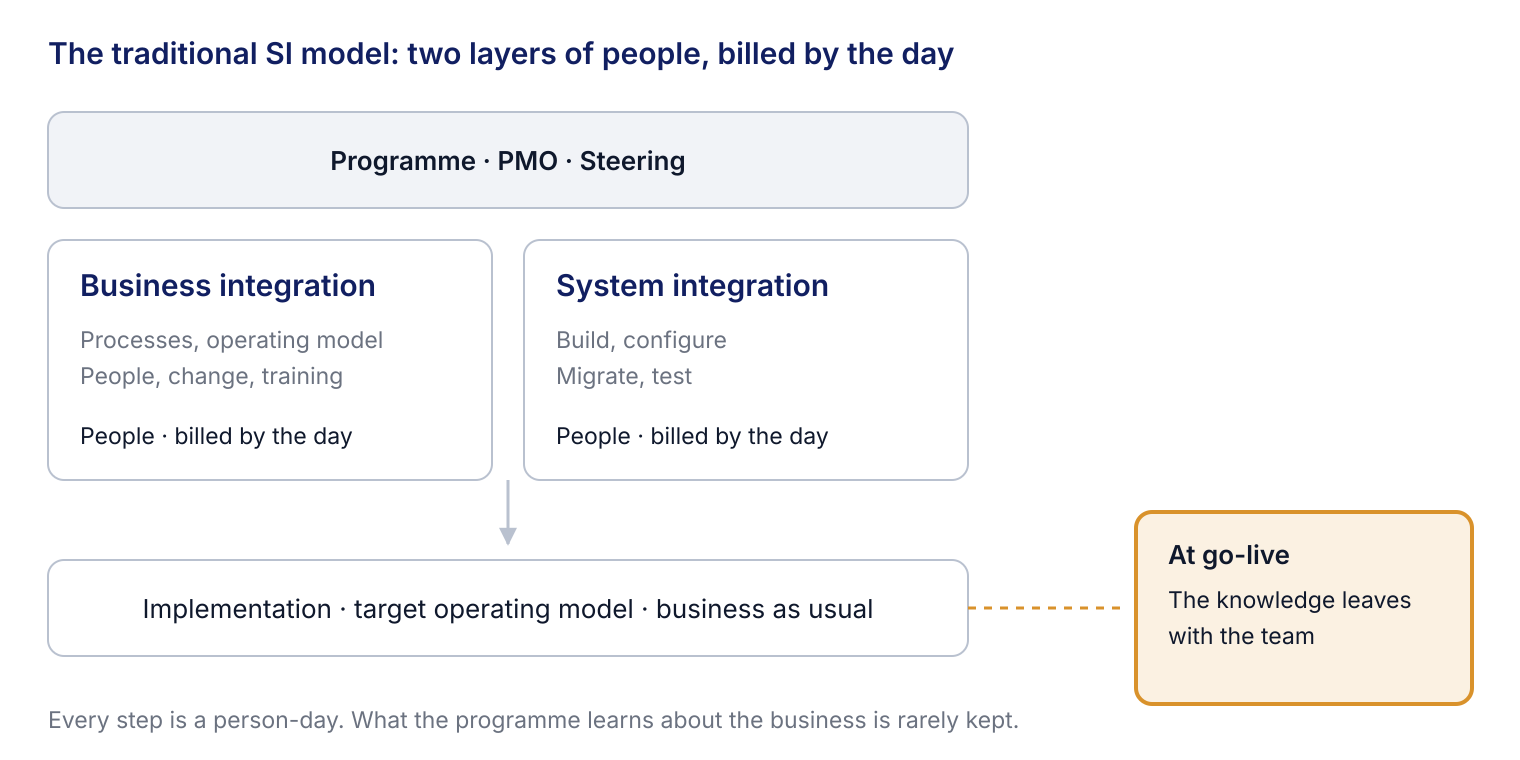
The model has three structural weaknesses. Every step is a person-day, so cost scales with headcount, not value. The current state is rediscovered in workshops at the start of every programme. And the knowledge built along the way lives in the heads of a project team that leaves at go-live, or in documentation that is written once and never updated.
Boards and the C-suite judge these programmes on the triple constraint of project management: scope, cost and time. In the traditional model, drift in any of the three usually becomes visible only once it is costly, or too late, to fix.
Why the traditional BI/SI model is dying
Actually, the model is already dead, even if corporates and PE funds have not yet buried it: the logic behind it no longer holds, but it is still being bought.
The disruption is not agents replacing consultants. It is that the most critical and expensive part of a programme – finding out how the business really runs and turning that into a design and a multi-year transformation roadmap – no longer needs a business or system integrator.
Discovery starts from the system, not from workshops. An ERP that has run for years has already recorded how the business works. AI can read its history and documentation, reconstruct the as-is processes and write down the open questions. Process owners answer them in their own time instead of sitting in weeks of workshops.
Design becomes mapping, not invention. AI is good at gap analysis, which is comparing reality with a reference. Baseline the as-is against SAP’s clean-core standard and the difference is the scope: measurable, explainable and traceable back to its source.
Slippage becomes visible early. With one source of truth and a named reviewer for every decision, movement in scope, cost and time shows up in real time, while it can still be corrected by a decision. It no longer surfaces months later as a rescue programme.
The two delivery models compared
BCG estimates that generative AI can already cut the effort of an organisation-wide ERP implementation by 20–40%. McKinsey expects AI agents to reduce implementation effort by at least 50% and to halve programme duration. At Qorelo we think these estimates are conservative.
Sources: BCG, “GenAI Can Revolutionize ERP Transformations” (2025); McKinsey, “The end of ERP as we know it?” (2026).
The human layer does not change. A milestone owner still decides, and programme leadership still owns the go-live. The decisions stay with your key people, and integration partners move from selling hours to delivering milestone-based outcomes.
The new model: a value creation wheel
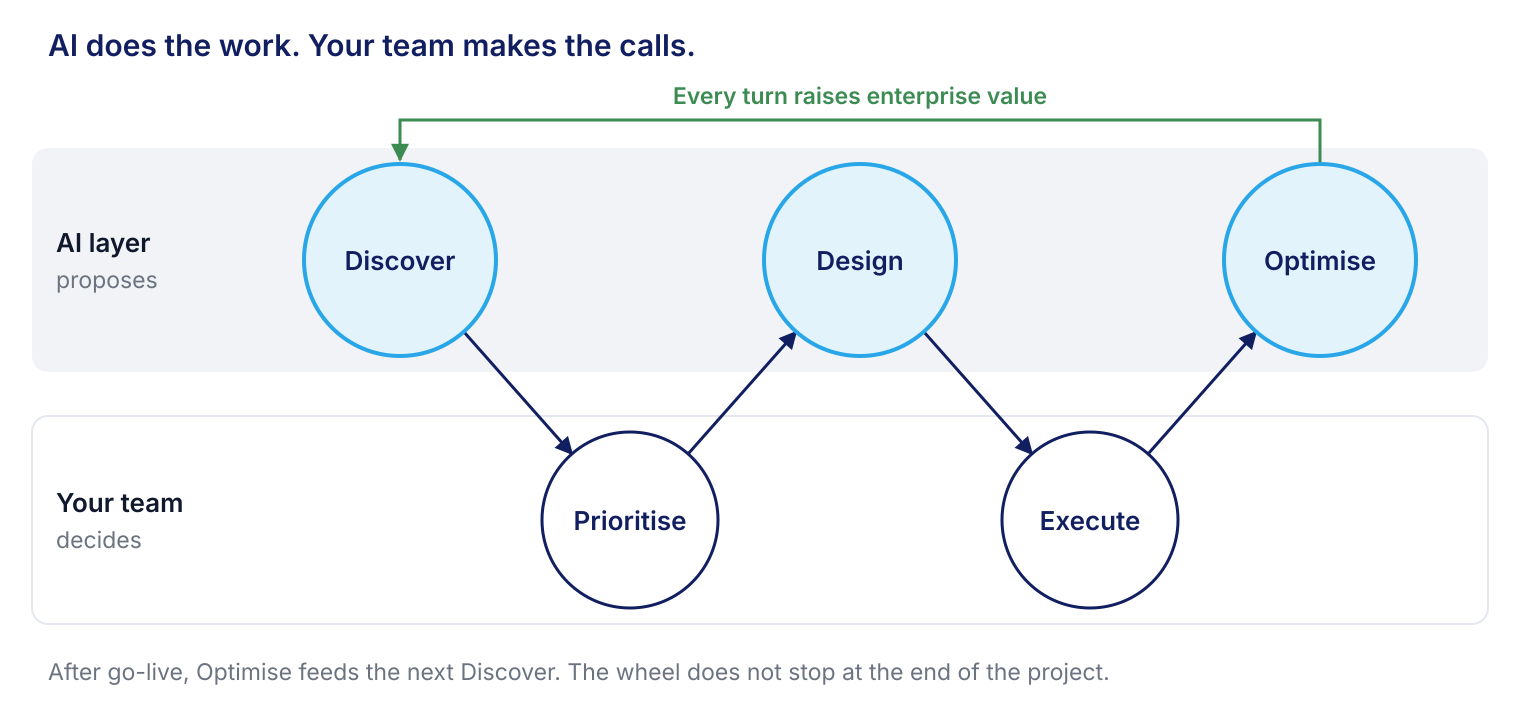
The legacy programme ran in a straight line: gather, design, build, go live and hand over to application management support. The model that replaces it is a loop, with a clear split between what AI analyses and what people prioritise and decide. It lets the enterprise, or the PE fund behind it, drive the value and manage the delivery vendors. It also continues after go-live, starting again from a new baseline.
The value creation wheel
Discover (AI). Reconstruct the as-is from system data and documents, and generate the open questions.
Prioritise (your team). Decide what goes first, by impact. This ordered list is the value creation plan.
Design (AI). Map the as-is against the clean-core standard. The difference is the scope.
Execute (your team). Build, test and go live, with your integration partner.
Optimise (AI). After go-live, detect where processes drift and where users work around the system, and feed that into the next turn.
The two decisions that matter most, what to do first and when to go live, stay inside your organisation.
After go-live, the wheel keeps turning
In the traditional model, value creation stops at go-live. The business case is considered delivered. In the new model, go-live is where the second business case starts. The platform that ran the transformation stays in the live system. It supports change requests, shows where processes and custom code drift from the standard, and points to the next value creation opportunity.
The knowledge base built during the transformation belongs to the company and stays with it, and every decision remains traceable. This is what turns a one-off project into a continuous value release cycle that keeps lowering the total cost of ownership.
What it means for enterprise value
An S/4HANA programme is usually sold as an end point. In the new model it keeps releasing value after go-live, as functional maturity grows and agents take on more of the work.
The S-curve of enterprise value
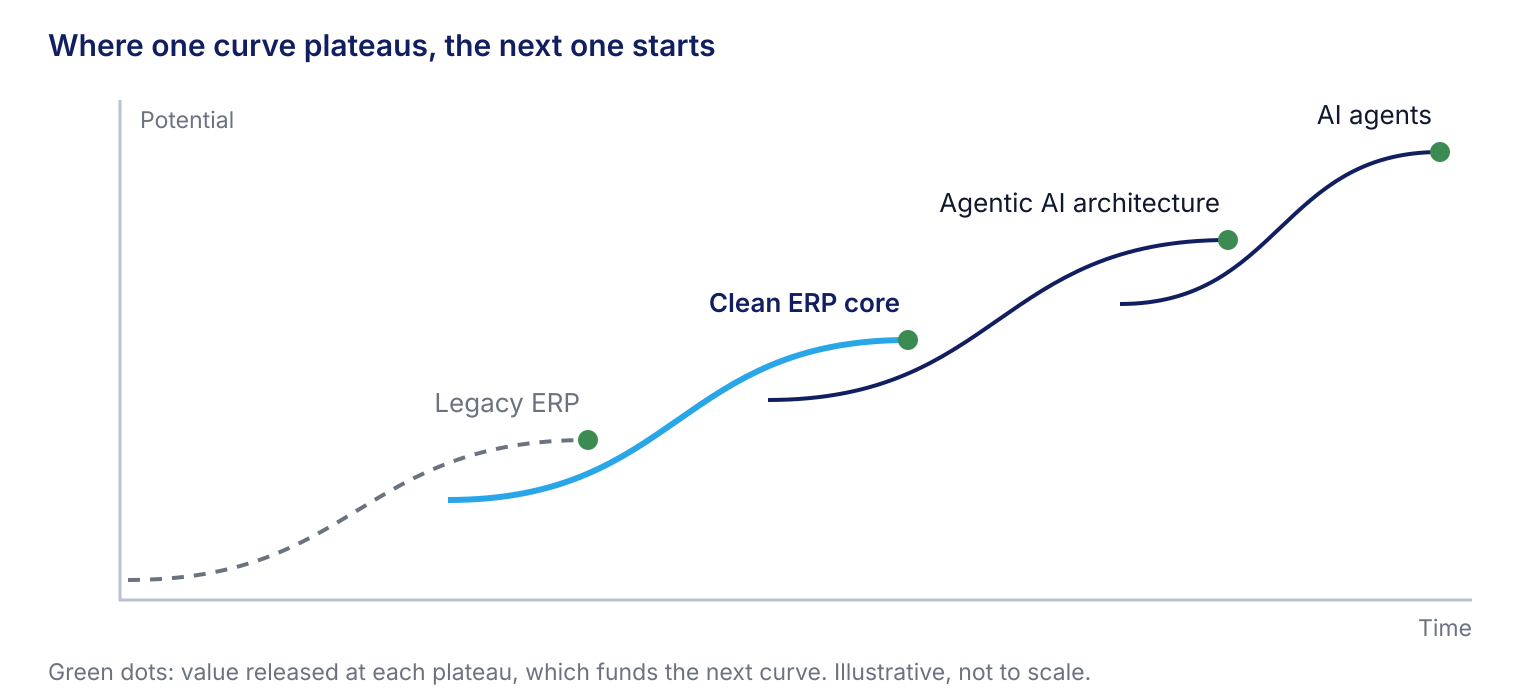
Each technology curve has a clear start and a clear end. Where it plateaus, value is released and the next curve has to start. Every board, C-suite and investor wants an AI strategy, but very few have the standardised processes and clean core that AI depends on. An agent can run a financial close or a forecast when the process is standard and the data is clean. It cannot run a process that nobody is able to describe.
That makes the transformation the foundation and not the finish line.
For the CIO: less implementation risk, less technical debt and a programme they can manage proactively and with full visibility.
For the CFO: a business case measured against a baseline with clear benefits realisation, and running costs that fall after go-live instead of rising.
For investors: a transformation that reads like a value creation plan, with enterprise value that can be demonstrated at exit.
What Qorelo is
Qorelo is the AI platform for SAP design, delivery and optimisation, and the consulting team around it, built for this model. The platform does the legwork, your people make the calls, and the consulting runs in the platform.
Discover
Qorelo reads the system and builds the baseline of how the business runs today, process by process, without weeks of workshops.
Prioritise
It puts effort, cost and risk next to each process, so that your team can decide what goes first.
Design
It maps the baseline against the methodology and shows the gaps, each traceable to its source so that the design is right first time.
Execute
Your integration partner builds; you stay in control. Qorelo keeps one source of truth for scope, cost and time, flags slippage as it happens and keeps the transformation programme on track.
Optimise
After go-live, the same baseline shows where the next improvement is.
Qorelo delivers value in two separate business cases, both measured against that baseline:
The first is in programme delivery, covering design and implementation: fewer consulting days and a programme that stays within scope, budget and timeline.
The second is the optimisation that starts after go-live: better processes, lower running costs and a clean core that AI agents can work on and keep improving over time.
Qorelo delivers risk mitigation, client empowerment, real-time decision-making, auditable implementation results, proactive project management, optimised vendor contract negotiations, PMO support and a safer ROI on your capital allocation. At the same time, we standardise your processes so they release value, enabling agentic AI to take over and keep improving over time.
Conclusion: the dinosaur will soon be extinct
The traditional BI/SI model was built for a world where the only way to understand a business was to send people into time-consuming workshops to manually piece together a multi-year transformation roadmap, an approach with a high failure rate. That world is ending and will soon be gone. Enterprises that keep paying people to rediscover their own business will pay a high price twice: once for the failed implementation programme, and again when they try to implement AI on top of a deficient architecture.
The firms that raise enterprise value will not be the ones with multi-million-dollar spend on consultants. They will be the ones that turn to AI for their SAP programme design and implementation, delivering against a value creation plan whilst keeping the optimisation wheel turning. The future has arrived, and Qorelo is the key to a successful SAP implementation (or rescue).
About the authors
Louis Schmidlin is the CEO and co-founder of Qorelo, the AI solution for SAP transformation. Cuauhtémoc Velasco Aznar is Chief Consulting Officer at Qorelo and has spent 25+ years in finance transformation and value creation.