Industry Trends
AI in ERP
ERP Strategy
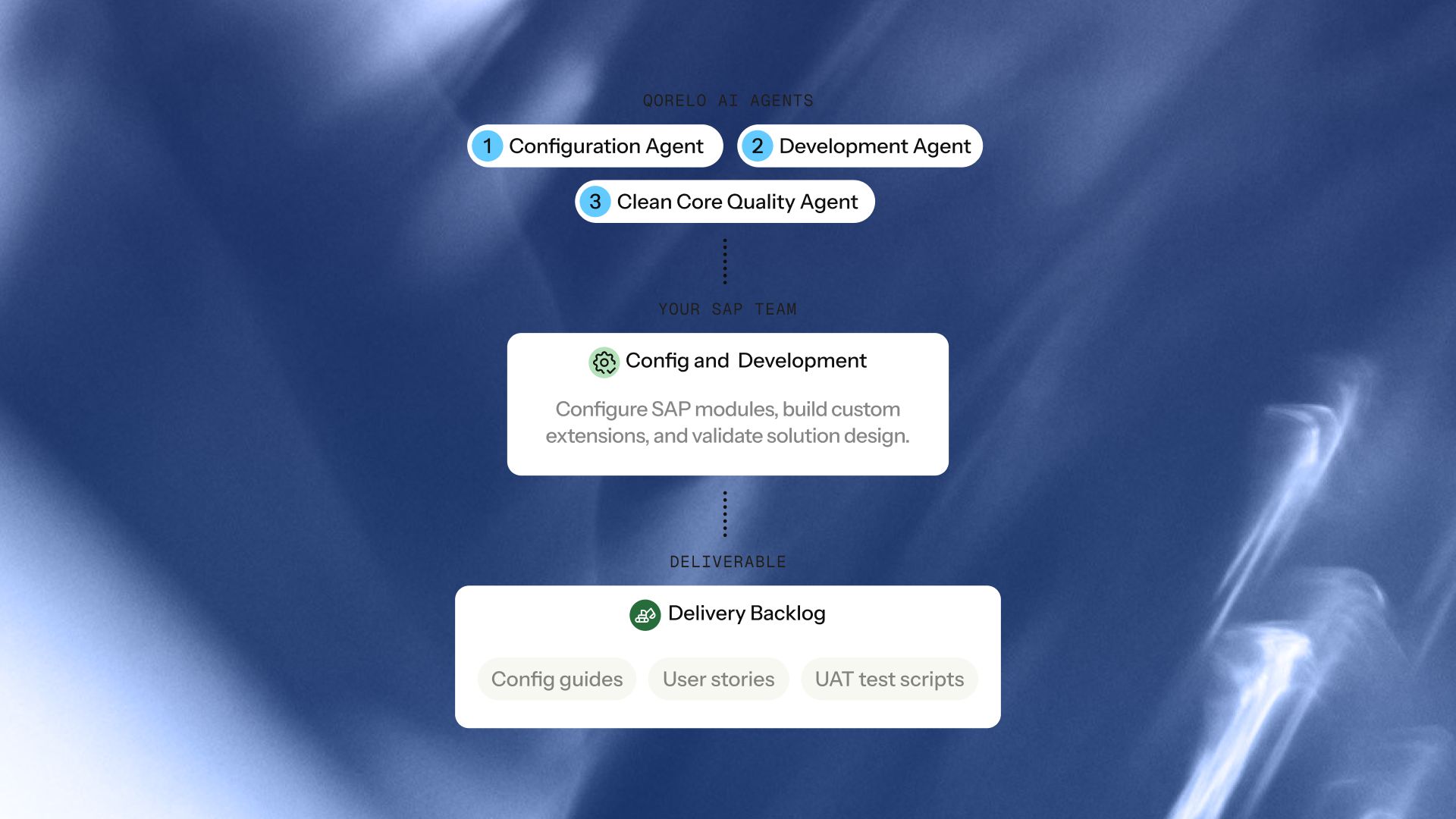
ERP transformations are entering a structural break. The 2020–2025 playbook—heavy discovery, workshop-centric alignment, manual documentation, and "train-the-users-at-the-end" change management—will not survive 2026's combined pressures: constrained transformation budgets, talent scarcity, compliance scrutiny, and accelerating AI capability.¹
This article presents Qorelo's three convictions for 2026. We argue that the primary unit of progress will shift from meetings to auditable deliverables, that adoption will be treated as a measured operational outcome rather than a training activity, and that "ERP transformation" will increasingly behave like a continuous operating system rather than a one-off program. We outline the theoretical lens behind each conviction, why we believe it is already unfolding, what it implies for leaders, and why Qorelo is building directly into this future.
ERP programs have always been complex, but complexity used to be "priced in." In 2026, that changes. Boards and CFOs are no longer funding transformation overhead as a blank check; they are funding outcomes—faster cycle times, better working capital, compliant controls, and measurable adoption. Meanwhile, AI has crossed a threshold where it can reliably produce structured outputs from unstructured inputs—if it is constrained by domain rules, governance, and traceability.
Our view is simple: the transformation bottleneck is no longer configuration capacity. It is discovery throughput and decision latency. The organizations that win in 2026 will compress the distance between stakeholder intent and execution-grade artifacts—without sacrificing control.
This is not a forecast built on novelty. It is built on recurring patterns we see across ERP transformations:
We turn those observations into three bold claims.
In most ERP programs, discovery produces "raw material," while delivery requires "finished goods." When the conversion from raw material to finished goods is slow or inconsistent, programs accumulate inventory, increase rework, and delay downstream execution.
The key implication is commercial: once outputs can be standardized, counted, reviewed, and traced, transformation can be priced like production—by units of value delivered, not by time spent.²
In 2026, consultancies will face an uncomfortable reality: the market is no longer willing to pay a premium for "presence." It will pay for progress.
Conviction: In 2026, ERP transformation pricing will increasingly move from day-rate / time-and-materials to outcome-based pricing—and consultancies will feel direct pressure to prove quality and throughput.
This is not vague "value pricing." It becomes concrete and testable:
The outcome is that delivery organizations must operationalize quality: standard formats, review workflows, versioning, and measurable throughput—because those become the basis for commercial trust.
Qorelo is designed for a world where transformation must be priced and governed by deliverables. We convert scattered discovery inputs into execution-grade outputs with traceability back to source material, so progress is visible and reviewable, not anecdotal.
In most ERP programs, discovery creates "raw material" (notes, transcripts, emails, BRDs, workshop outputs). Delivery requires "finished goods" (requirements, fit–gap decisions, process flows, backlog items, test cases). The failure mode is the same as in any supply chain: if you cannot convert raw material into standardized outputs quickly and consistently, you build inventory (meetings), increase rework (repeat workshops), and delay shipments (build).³
In 2026, the economics of discovery become intolerable:
Bold claim: By end of 2026, high-performing ERP programs will treat "workshops" as a last resort—not a default. They will run fewer meetings, but produce more deliverables per week.
Qorelo is built around a deliverables-first doctrine: convert scattered discovery inputs into execution-grade outputs with traceability back to sources. That means:
AI is not a feature; it is a production capability. In ERP, production capabilities must satisfy enterprise constraints:
The organizations that treat AI as a controlled production system will scale it. Those who treat it as a generic assistant will keep it in experimentation.⁴
Two forces collide in 2026:
Bold claim: The winning AI in ERP will not be the model with the best prose. It will be the system with the best control plane: permissions, traceability, output standards, integration into delivery workflows, and defensible governance.
Qorelo is engineered to be compatible with enterprise delivery realities:
If these convictions hold, the practical guidance is clear:
2026 will be remembered as the year ERP transformations stopped being primarily a coordination problem and started becoming an artifact and execution problem. The organizations that win will convert stakeholder intent into auditable deliverables faster than everyone else—and they will treat adoption as an operational KPI, not an afterthought. That is the future Qorelo is building for.
When you visit this site, it may store or read information on your device using cookies and similar technologies. Some are required to run the site; others are used only if you allow them. You can change your choice at any time from this panel.
Privacy policy Imprint Terms of service



.png)